Creating AI Voice Agents that Make a Profit
This article will help you create AI Voice Agent workflows that make migrating from IVRs a profitable task.

Introduction: the phone call is becoming intelligent
For many businesses, the phone is still the front door. A customer may discover you through a website, a social post, a referral, or a Google search, but the moment they need help, reassurance, pricing, scheduling, or a fast answer, they often reach for the phone. That is why the movement from traditional IVRs to AI voice agents matters. It is not simply a technology upgrade. It is a chance to redesign the first live moment between a caller and your company.
The problem is that many AI voice projects are introduced with the wrong expectation. The goal should not be to impress callers with a synthetic voice or to replace every human conversation. The goal is to build workflows that make the business more efficient, more responsive, and more profitable. A profitable AI voice agent is not a talking brochure. It is a trained operational tool. It answers promptly, understands why the person is calling, gathers the right information, completes simple tasks, routes more complex calls intelligently, and leaves a clean record for the human team.
That distinction is important. A business can spend money on AI and still create frustration if the agent has no clear boundaries, cannot transfer calls properly, asks the same questions twice, or gives answers that sound confident but are not reliable. On the other hand, a modest AI voice deployment can create real profit when it saves missed calls, captures leads after hours, shortens repetitive calls, improves appointment booking, and helps employees start each conversation with context instead of confusion.
This article is written for owners, operators, managers, and technical teams who want to migrate from IVRs to AI voice agents in a practical way. It is intentionally not a hype piece. The companies that will win with AI voice agents are the ones that design them like business processes, not like gadgets.
Why traditional IVRs stopped feeling good enough
The classic IVR was designed for a different era. Its job was to reduce the burden on staff by forcing callers through menus: press 1 for sales, press 2 for support, press 3 for billing, and so on. For some organizations, that still works reasonably well. But for many small and medium-sized businesses, the IVR has become a source of friction. The caller has to translate a real problem into the company’s internal department structure. If the menu is too long, unclear, or outdated, the caller feels trapped before the conversation has even started.
This is one reason customers often press zero, repeat 'representative,' or abandon the call. The IVR asks the caller to adapt to the phone system. A good AI voice agent reverses that relationship. It lets the caller explain the reason for the call in ordinary language, then maps that request to the correct workflow. A caller should not need to know whether their issue is sales, operations, scheduling, retention, support, or billing. The system should understand enough to move the call in the right direction.
There is also a business problem. IVRs frequently hide waste. A call may be answered, but not handled. A lead may reach the right menu, but not be captured. An after-hours caller may hear a message, but never receive a callback. A customer may leave a voicemail with incomplete information, forcing staff to spend time calling back just to discover what the caller wanted. The IVR appears to reduce workload, but in practice it may move the workload to a later, less efficient moment.
AI voice agents create profit when they remove that hidden waste. They are most valuable when they convert a vague incoming call into a useful business object: a booked appointment, a qualified lead, a support ticket, a payment reminder, a structured message, a callback task, or a properly routed live transfer.
Profit starts with a workflow, not with a voice
One of the most common mistakes in AI voice adoption is starting with the voice. Businesses spend time choosing whether the agent sounds warm, formal, young, mature, cheerful, or polished. Voice quality matters, of course. Callers will judge the experience within seconds. But the voice is not where the profit is created. Profit is created in the workflow behind the voice.
A workflow answers five questions. First, what kind of caller is this? Second, what does the caller want to accomplish? Third, what information must be collected before the business can act? Fourth, can the agent complete the task safely, or should it transfer to a person? Fifth, what record should remain after the call? If these questions are not answered, the agent may sound excellent and still fail commercially.
Consider a medical spa, a dental office, a law firm, a contractor, or an insurance advisor. Each receives calls that have different economic value. A new consultation request, a complaint, an emergency, a billing question, and a vendor inquiry should not be treated the same way. The agent needs to recognize intent and urgency. It also needs to know what not to do. A profitable agent does not over-answer. It does not guess. It does not pretend to be a licensed professional. It gathers, guides, and escalates when needed.
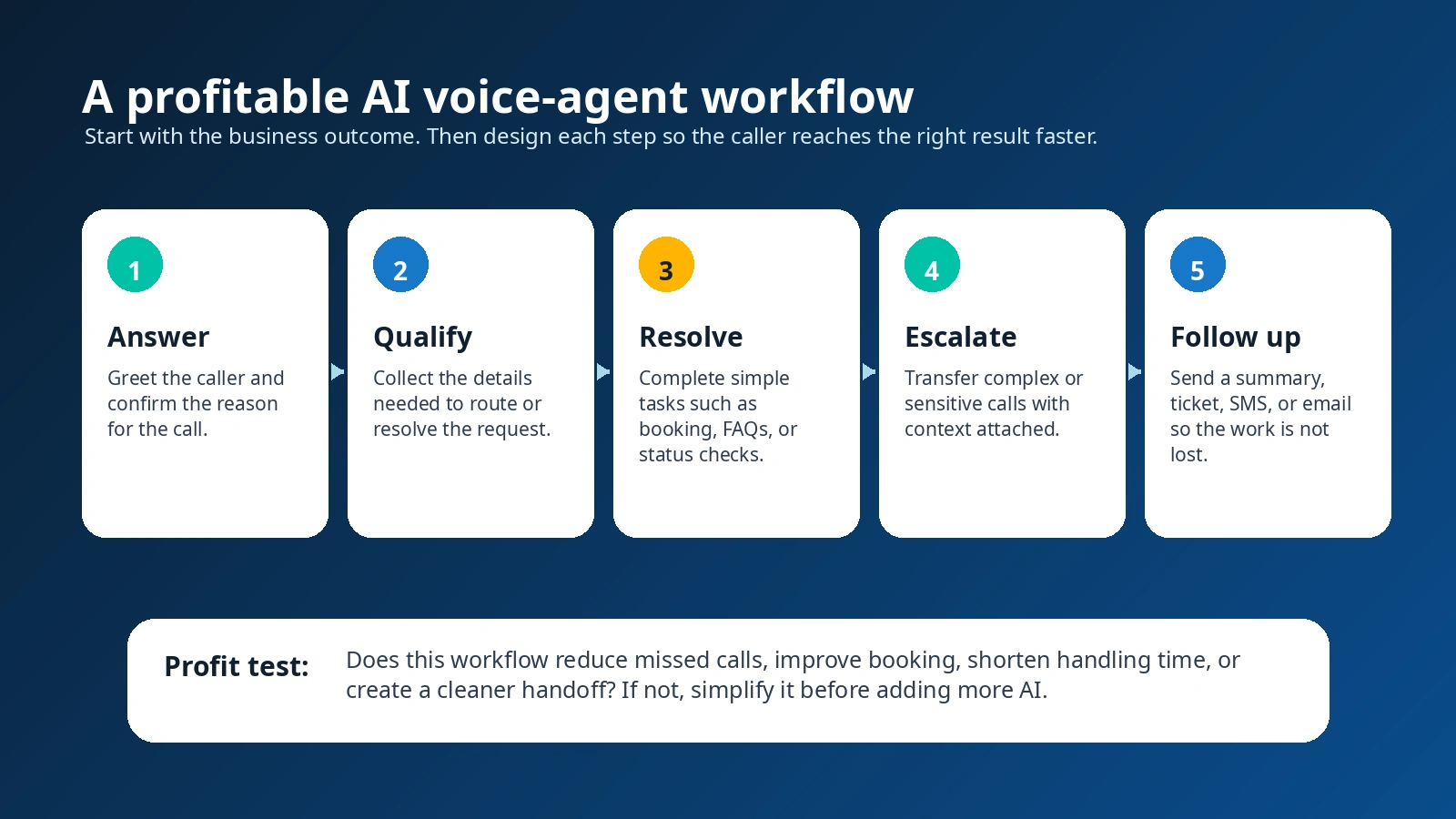
The simplest profitable workflow is: answer every call, identify intent, collect minimum useful information, resolve simple requests, escalate complex requests, and document the outcome. When a business begins there, it can improve the agent over time without making the first deployment dangerously complicated.
What makes an AI voice agent economically useful
An AI voice agent becomes economically useful when it affects one or more measurable business outcomes. The first outcome is missed-call recovery. Many businesses lose revenue because calls arrive during busy periods, lunch breaks, evenings, weekends, holidays, or moments when staff are helping someone else. If the agent captures the caller’s name, number, reason for calling, urgency, and preferred callback time, the business has preserved an opportunity that might otherwise disappear.
The second outcome is better qualification. Not every caller is ready to buy, book, or proceed. Some are gathering information. Some are outside the service area. Some need a service the business does not provide. Some are ideal prospects. A good AI voice agent can ask a few respectful questions and route the lead accordingly. This protects staff from spending equal time on unequal opportunities.
The third outcome is faster resolution of repetitive requests. Every business has common calls: hours, location, appointment availability, document requirements, service descriptions, preparation instructions, status updates, and simple account questions. When these calls are answered consistently, staff can focus on higher-value work.
The fourth outcome is improved handoff quality. The agent should not merely transfer a call. It should transfer with context. A warm handoff might include the caller’s name, reason for calling, urgency, and the information already collected. Even when the transfer is not live, the note should be useful enough that a human can act without starting from zero.
The fifth outcome is follow-up. A call that ends without a next step is often a wasted interaction. A profitable workflow may send a confirmation message, create a callback task, notify a staff member, update a CRM, or email a summary. The follow-up is where many AI voice agents quietly become revenue tools.
Use AI where it lowers friction, not where it removes judgment
The best AI voice workflows are not built around the question, 'Can AI do this?' They are built around the question, 'Should AI do this part of the process?' That is a more disciplined question. AI can often answer, summarize, classify, and collect information. But human judgment remains essential when the situation is sensitive, ambiguous, emotional, high-value, regulated, or unusual.
This is why the most successful model is usually hybrid. The AI agent handles routine volume and prepares the conversation. The human team handles nuance, relationship-building, negotiation, reassurance, professional advice, exceptions, and final decisions. In this model, AI does not make the business less human. It gives the human team more room to be human where it matters.
For example, a financial services office may use an AI voice agent to identify whether a caller wants an appointment, policy information, a document checklist, or a callback. The agent should not provide individualized financial advice. A clinic may use the agent to capture appointment requests and preparation questions, but it should escalate clinical concerns. A contractor may use it to collect job location, service type, photos by text link, and urgency, but a human may still price the work. The agent increases speed without pretending that every call can be fully automated.
That boundary protects profit because it protects trust. A bad AI interaction can cost more than it saves. The point is not to automate the entire relationship. The point is to automate the parts that make the relationship easier to begin, manage, and continue.
Designing the migration from IVR to AI voice agent
A migration from IVR to AI should begin with call mapping. Before writing prompts or choosing a platform, list the top reasons people call. Use call recordings, staff interviews, voicemail patterns, website form submissions, and receptionist notes. Most businesses discover that a small number of reasons account for a large share of calls. Those reasons become the first workflows.
Next, identify the value of each workflow. Which calls create revenue? Which calls reduce churn? Which calls protect reputation? Which calls waste staff time? Which calls must be handled carefully because of compliance or safety? A profitable migration does not treat all calls as equal. It automates first where the business case is strongest and the risk is manageable.
Then define the minimum data set for each workflow. This is critical. AI voice agents sometimes fail because they either collect too little information or ask too many questions. The caller should feel helped, not interrogated. For a callback request, the minimum data may be name, phone number, reason for calling, urgency, and preferred time. For an appointment request, it may include service type, new or existing customer, preferred location, preferred date range, and consent to receive a confirmation message. For technical support, it may include account identifier, affected service, symptoms, when the problem began, and best callback number.
After the data set is clear, design the escalation rules. Which calls transfer immediately? Which calls generate a priority alert? Which calls can wait for normal business hours? Which topics should the agent refuse to answer and route to staff? Escalation rules are the guardrails that keep the agent useful and safe.
Finally, decide where the record goes. A conversation summary sitting inside an AI platform may be better than nothing, but it is not operationally complete. Ideally, the call outcome should reach the place where the team already works: CRM, helpdesk, email inbox, shared dashboard, scheduling tool, or ticketing system. Profit improves when the call record becomes action, not archive.
A practical framework: qualify, route, resolve, record, follow up
A simple framework can keep the project grounded: qualify, route, resolve, record, follow up. These five verbs describe what an AI voice agent must do to create business value.
Qualify means the agent understands the purpose of the call and gathers the information needed to determine next steps. Qualification should be natural and brief. The agent can say, 'I can help get this to the right person. May I ask a couple of quick questions?' That phrase is more respectful than launching into a script.
Route means the agent sends the caller to the right destination. Routing may be a live transfer, a priority notification, a scheduled callback, or a department-specific message. Good routing depends on caller intent, urgency, value, and availability. A new sales opportunity may deserve a different path than a routine administrative question.
Resolve means the agent completes simple tasks without unnecessary human involvement. Examples include answering business hours, confirming address, explaining what documents to bring, taking a message, checking a simple status from an approved source, or booking a basic appointment when scheduling integration exists.
Record means the agent creates a clean summary. The record should be short, structured, and useful. Staff do not need a transcript of every sentence before they know what to do. They need the caller’s identity, the reason for contact, key details, urgency, promised next step, and any limitations or uncertainty.
Follow up means the system closes the loop. This might be a text message to the caller, an email to staff, a ticket in the helpdesk, or a calendar invitation. Follow-up is where accountability lives. Without it, the AI voice agent may have a pleasant conversation but still fail the business.
Examples of profitable AI voice workflows
For a medspa or clinic, the agent can handle new consultation inquiries, capture the treatment of interest, ask whether the caller is a new or returning client, offer basic preparation instructions approved by the clinic, and create a booking request. It should avoid diagnosis, treatment promises, or individualized medical recommendations. Profit comes from capturing leads quickly and reducing front-desk overload.
For a professional services firm, the agent can screen appointment requests, identify the service category, collect contact details, ask whether the matter is urgent, and route the request to the appropriate advisor. Profit comes from protecting high-value professional time while making the caller feel heard.
For a trades business, the agent can collect address, service type, urgency, photos by text link, access instructions, and preferred appointment windows. It can distinguish between emergency and non-emergency requests and alert the correct person. Profit comes from faster dispatch and fewer missed opportunities after hours.
For a VoIP provider, the agent can help callers identify whether they need sales, porting, billing, technical support, or provisioning. It can collect the account name, affected number, device type, symptoms, and callback information. It can also direct urgent outages differently from general inquiries. Profit comes from reducing repetitive triage and improving support notes.
For an e-commerce business, the agent can collect order numbers, clarify whether the request is shipping, return, product information, or warranty, and create a structured ticket. Profit comes from reducing inbound email clutter and helping staff respond faster.
Each of these workflows has a different script, but the same philosophy: the agent should not try to be impressive. It should try to be useful.
Measurement: how to know whether the agent is making money
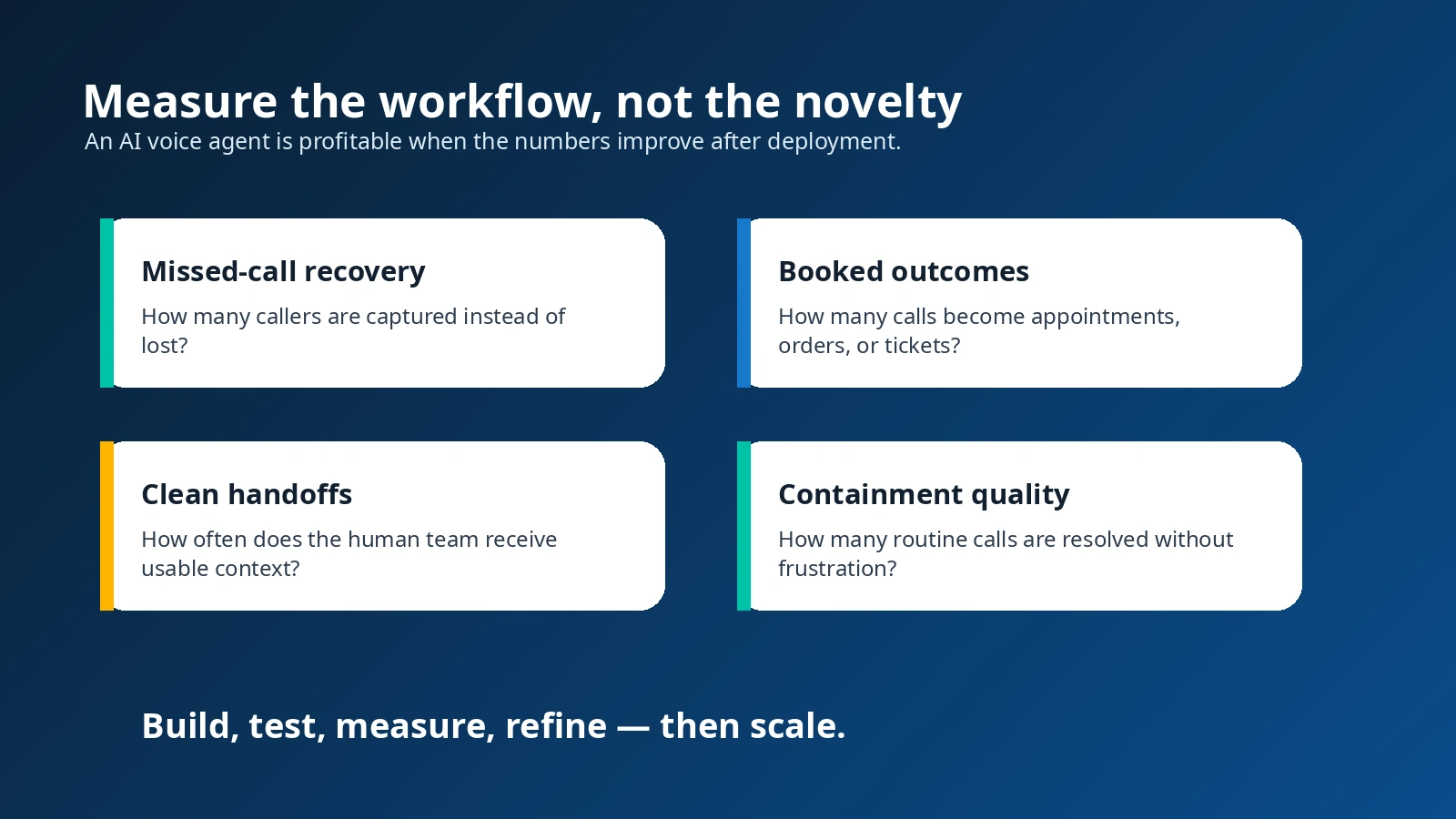
A voice agent should be measured like any other operational investment. The most basic metric is containment, but containment alone can be misleading. If the agent keeps callers away from humans by frustrating them, containment may look good while the business loses trust. Better metrics connect the agent to outcomes.
Start with missed-call recovery. How many calls were answered by the agent that previously would have gone unanswered? How many became callbacks, appointments, tickets, or sales opportunities? Then track booking or conversion outcomes. If the agent captures more qualified leads, the sales team should be able to see it.
Measure time savings carefully. If staff no longer spend the first two minutes of every call asking for basic details, that time has value. If support staff receive better notes, they can solve problems faster. If front-desk staff are interrupted less often, in-person service may improve.
Track escalation quality. A transfer is only valuable if the receiving person knows why the call is being transferred. Random transfers create frustration. Contextual transfers create efficiency. The note quality should be reviewed regularly, especially during the first month.
Also track risk signals. How often did the agent fail to understand? How often did callers ask for a human? Did the agent provide an answer outside its approved knowledge? Were there privacy concerns? Did any caller receive a promise the business could not keep? These are not technical footnotes. They are profit protection metrics.
A useful dashboard may include missed calls recovered, qualified leads captured, appointments requested, calls resolved without staff involvement, average call duration, human escalations, failed-intent rate, caller sentiment, and revenue attributed to AI-assisted calls. The goal is not to prove that AI is clever. The goal is to prove that the workflow improves the business.
Common mistakes that destroy ROI
The first mistake is trying to automate too much too soon. A business may be tempted to build an agent that answers every question, handles every department, books every service, updates every system, and replaces every call path. That ambition often creates a fragile system. Start with high-volume, low-risk workflows and expand only after testing.
The second mistake is using vague instructions. A prompt that says 'be helpful and answer customer questions' is not a workflow. The agent needs approved knowledge, boundaries, escalation triggers, tone guidance, data collection rules, and fallback behavior. It should know when to say, 'I do not want to guess on that. I can have someone contact you.'
The third mistake is ignoring handoffs. Many AI demos sound good until the caller needs a person. If transfer logic is weak, the business has simply replaced one frustration with another. Every workflow should define what happens when the agent is uncertain, the caller is upset, the request is urgent, or the topic is outside scope.
The fourth mistake is failing to train the human team. Staff need to understand what the agent will do, what information it will collect, where notes will appear, and how to correct problems. AI voice agents are not just customer-facing tools. They change internal operations.
The fifth mistake is treating launch as the finish line. The first version of an AI voice agent is a starting point. Real improvement comes from reviewing calls, studying failed intents, updating knowledge, improving scripts, and tightening escalation rules. The best systems become more profitable because the business treats them as living workflows.
The trust layer: compliance, privacy, and caller confidence
Trust is not optional. A caller may forgive a simple menu. They are less likely to forgive an AI voice agent that mishandles personal information, invents an answer, or creates uncertainty about whether they are speaking with a person. Businesses should be transparent enough that callers are not misled, while still keeping the experience natural and professional.
The agent should only use approved knowledge. It should not improvise policies, pricing, guarantees, clinical advice, legal advice, financial advice, or technical commitments. When the answer depends on a professional judgment or current account-specific information, the agent should escalate.
Privacy design should be part of the workflow from the beginning. Decide what information the agent may collect, where it is stored, who can access it, how long it is retained, and whether sensitive information should be avoided in summaries. The smaller the necessary data set, the easier it is to manage risk.
Caller confidence also depends on tone. A good agent should be polite, brief, and clear. It should not pretend to be emotionally deep. It should not over-apologize. It should not bury callers in disclaimers. It should guide the caller through the next step with calm competence.
A practical implementation roadmap
A sensible implementation begins with discovery. Review call types and choose two or three workflows with clear value. Do not start with the most complex call. Start where the agent can help quickly and safely.
The second step is scripting the conversation flow. This is not the same as writing a rigid script. It means defining the greeting, the information to collect, the decision points, the escalation rules, the approved answers, and the closing message. The agent should sound conversational, but the workflow behind it should be structured.
The third step is integration planning. Decide whether the agent will send email summaries, create tickets, update a CRM, book appointments, send SMS confirmations, or transfer calls. An AI voice agent with no integration can still be useful, but the strongest profit usually appears when the agent connects to real operations.
The fourth step is testing. Test with friendly callers, staff members, edge cases, background noise, accents, interruptions, vague requests, and impatient callers. Listen for moments where the agent asks too many questions, misses intent, sounds unnatural, or fails to escalate.
The fifth step is phased deployment. Begin with after-hours calls, overflow calls, or a single department. Review outcomes before expanding. A phased rollout builds confidence and protects the brand.
The sixth step is continuous improvement. Schedule regular reviews. Update knowledge as services, prices, hours, policies, and staff availability change. Measure business outcomes, not just call counts. The agent should become part of operational management, not a forgotten technical installation.
Conclusion: the profitable future is practical
AI voice agents will not make every business profitable simply by answering the phone. Profit comes from design. It comes from choosing the right workflows, respecting the caller’s time, helping staff focus, protecting trust, and measuring outcomes that matter.
The migration from IVR to AI is an opportunity to rethink the phone experience. A traditional IVR says, 'Choose from our menu.' A good AI voice agent says, 'Tell me what you need, and I will help get it handled.' That shift can feel small, but it changes the relationship between the caller and the business.
For small and medium-sized businesses, this is especially powerful. They may not have large call centers, but they do have missed calls, repetitive questions, busy staff, after-hours inquiries, and opportunities that slip away. An AI voice agent can help preserve those opportunities. It can also make the business feel more responsive without forcing employees to be available every minute of the day.
The most profitable AI voice agents are not the loudest or most futuristic. They are the ones that quietly do useful work. They answer, qualify, route, resolve, record, and follow up. They know when to help and when to hand off. They make the caller feel guided instead of trapped. They give the business better information and better timing.
That is the real promise of AI voice agents. Not a replacement for human service, but a better front door to it.
Practical takeaway
The profitable AI voice agent is not the one that talks the most. It is the one that answers, qualifies, routes, resolves, records, and follows up with the least friction and the greatest trust.
References
- Gartner: Gartner predicts agentic AI will autonomously resolve 80% of common customer service issues by 2029 and reduce operational costs by 30%. Source
- Deloitte Canada: Deloitte notes that contact centres often struggle to integrate new technology, identify clear AI use cases, and align talent and operations. Source
- McKinsey & Company: McKinsey frames the future contact center around finding the right mix of humans and AI rather than choosing one over the other. Source
- IBM Think: IBM describes conversational AI as a tool for understanding human language and supporting customer interactions across channels. Source
- Reuters: Reuters reported Gartner’s warning that many agentic AI projects may be scrapped by 2027 because of cost and unclear business value. Source